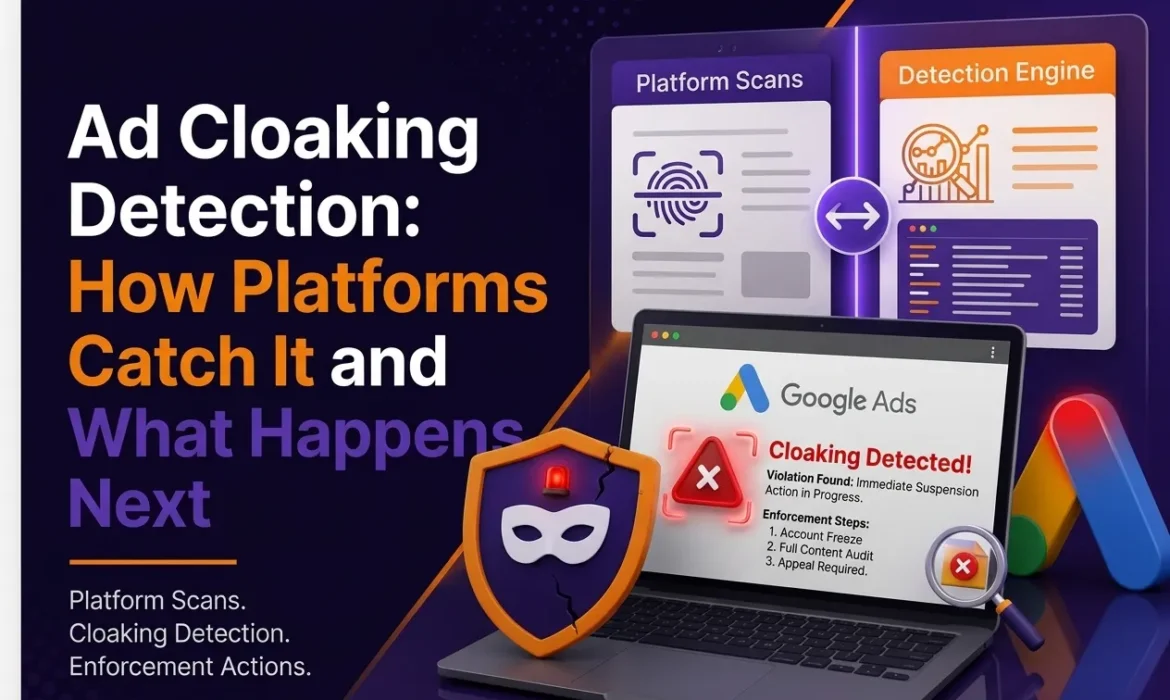
Picture an advertiser whose campaigns have run smoothly for weeks. Conversions are steady, so they’ve stopped checking the dashboard every hour. Then one morning an email arrives: the ad account has been suspended for circumventing systems. Spend stops, and the campaign history is suddenly out of reach.
That’s a common ending for ad cloaking. This guide explains, at a high level, how ad platforms detect cloaking, what usually follows, and why a business that doesn’t depend on avoiding detection is the stronger bet.
What Is Ad Cloaking?
Ad cloaking means showing ad reviewers or automated systems one version of an ad or landing page while real visitors see something different.
Google covers this under its Circumventing Systems policy. Meta, TikTok, Snapchat, Pinterest and Microsoft have comparable rules. The wording varies, but the principle is the same: what gets reviewed must be what customers actually see.
Not every redirect or personalized page counts as cloaking. Tracking links, localized pricing and language switching are routine when the content stays honest and consistent. The problem is concealing the real offer from review. For a closer comparison, see our guide to cloaking vs compliant landing pages.
How Do Ad Platforms Detect Cloaking?
Platforms don’t publish their full methods, and a technical breakdown wouldn’t help you build a healthy business anyway. The general picture is still useful, because it shows why “it hasn’t been flagged yet” isn’t a plan. In broad terms, platforms use several layers:
- Automated review. Systems scan ads, landing pages and account behavior at scale, and they’re updated continuously.
- Human review. Reviewers check flagged ads and accounts, especially in sensitive categories or after complaints.
- Repeat checks. Approval isn’t permanent. Ads and pages can be reviewed again at any time after launch.
- User reports. People who click an ad and land somewhere unexpected can report it, and those reports carry weight.
- Account-level patterns. Account history, linked accounts, payment details, complaint rates and past violations all add context.
- Outside signals. Regulators, payment providers and other partners also investigate deceptive advertising, and their findings can feed back into enforcement.
No single layer has to be perfect. Together they make long-term evasion unreliable, and improvements usually apply to every account at once.
Why “Nobody Caught Me Yet” Is a Weak Plan
Cloaking rarely fails gradually. It tends to fail all at once.
Take a hypothetical small online store running a restricted-category offer. For months everything works, so the owner scales spend and builds the whole business around one ad account. Then a policy update, a batch of complaints or a routine re-review changes the outcome. The account goes down, and the pixel data, audiences, campaign history and revenue stream go with it.
The real problem isn’t getting caught. It’s that the business was built on not getting caught.
What Happens After a Cloaking Suspension?
Outcomes depend on the platform, the severity and the account’s history, but they commonly include:
- Ad rejection or removal, sometimes with little explanation.
- Account suspension, often permanent for serious or repeated circumvention.
- Related assets affected, such as business managers, linked accounts, payment methods, pages and domains.
- Lost data and spend, including audiences, conversion history and any unspent balance.
- Difficult reinstatement. Circumventing systems is treated as a serious violation, and some decisions are final.
- Payment and hosting fallout. Processors and hosts can end relationships with merchants flagged for deceptive practices.
- Legal and regulatory attention. If the hidden content involved deceptive claims or restricted products, regulators may take an interest.
- Reputation damage. Visitors who land on something different from what the ad promised lose trust quickly, and complaints and chargebacks often follow.
Can You Appeal a Circumventing Systems Suspension?
Sometimes, but don’t count on it. Reinstatement is difficult and never guaranteed. If you appeal, follow the platform’s official process and keep these basics in mind:
- Be completely honest about what was on your pages and ads.
- Show what you’ve changed so the experience is now identical for everyone.
- Provide business documentation or verification if it’s requested.
- Stay calm and factual, and don’t blame the platform.
Don’t open new accounts to work around a suspension. That can turn a recoverable situation into a permanent one across your profiles, payment methods and business assets.
What to Do Instead of Cloaking
If ads keep getting rejected, the fix is almost always upstream:
- Find the real reason. Read the notice, identify the policy, and review your ad and page the way a reviewer would.
- Rework the claims. Remove guarantees, unverifiable results and prohibited wording for your category.
- Align the ad and the page. Same offer, same message, same experience for everyone.
- Get the right approvals. Regulated categories like finance, health products and gambling often have certification routes for advertising legally in approved regions.
- Review before launch. An outside policy review can catch problems before they cost you an account.
- Diversify. SEO, email, affiliates and partnerships mean no single ad account can sink the business.
FAQs
Can Google detect cloaking?
Google and other platforms combine automated systems, human reviewers and user reports, and they keep improving. Since no method stays reliable forever, building a business on the assumption of never being detected is risky.
How long does it take for cloaking to be detected?
There’s no predictable timeline. Some accounts are flagged quickly and others run for a while before enforcement catches up. That unpredictability is the problem.
What happens if my ad account is suspended for circumventing systems?
You may lose access to the account and its data, and related assets can be affected too. You can usually appeal, but reinstatement is difficult and not guaranteed.
Is ad cloaking illegal?
It’s mainly a platform policy violation. It can become a legal matter if it conceals deceptive claims, prohibited products or fraud.
What’s the safest way to get a restricted offer approved?
Check what’s allowed for your category, apply for any required certification, keep claims accurate, and make ads and landing pages consistent for every viewer.