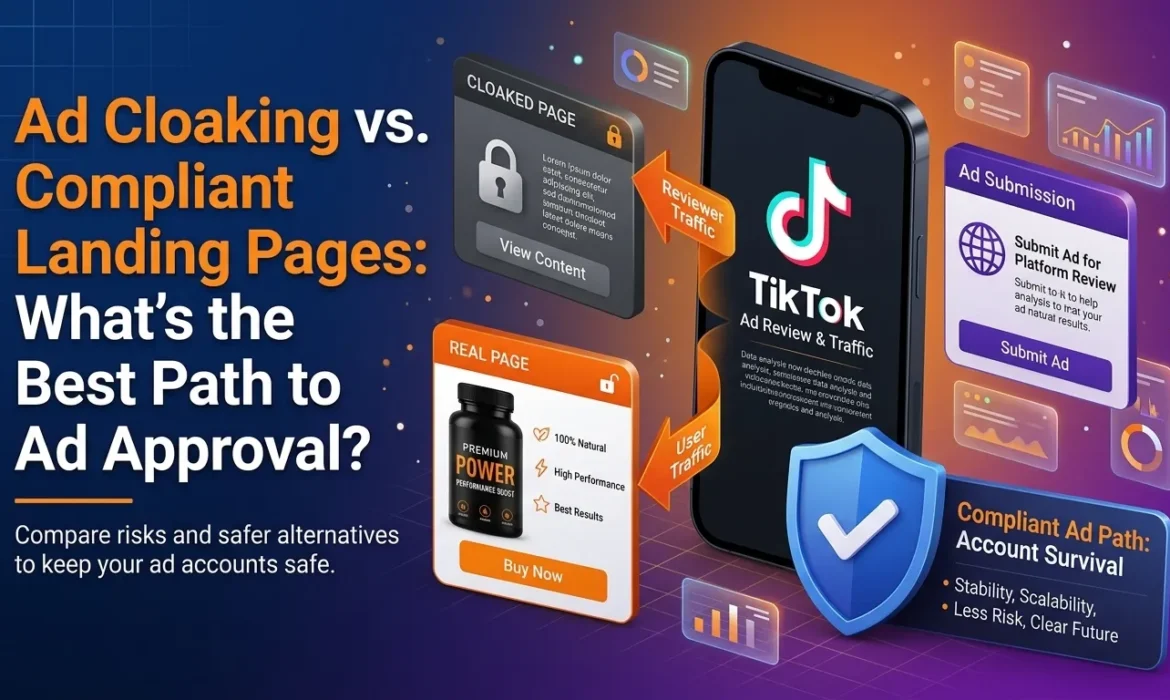
Your ad gets rejected. You tweak the creative, rewrite the headline and resubmit, and it’s rejected again. At that point cloaking can start to look tempting: show reviewers one version of the page and real visitors another.
That shortcut can cost you the entire ad account. Google treats cloaking as a violation of its circumventing systems policy, and accounts found violating it can be suspended without warning and barred from advertising again. A compliant landing page takes more work, but it gives your campaigns a future.
This guide compares cloaking and compliant landing pages, explains the main risks, and outlines safer alternatives when your ads keep getting rejected.
What Is Ad Cloaking?
Ad cloaking means showing an ad platform’s review systems different content from what ordinary users see, usually to conceal an offer, destination or policy issue that would otherwise fail review. Google defines it as showing different website content to different people, or to Google, to hide things that may break Google Ads rules.
It isn’t the same as normal personalization. Serving a page in the visitor’s language, adjusting offers by location, or using a legitimate click tracker can be acceptable when the promoted product or service stays the same and you aren’t trying to evade review.
The deciding factor is intent. If the purpose is to hide the true offer or destination from the reviewer, that’s cloaking, not optimization.
What Is a Compliant Landing Page?
A compliant landing page is the page your ad promises, presented honestly to reviewers and visitors alike. The ad, destination URL and on-page experience should match: same product, same offer, same business, and no surprise steps after the click.
Platforms increasingly review the whole journey, not just the ad. Pinterest says it looks at the ad experience from start to finish, including the URL, and doesn’t allow landing pages that create inconsistent experiences or promote products that aren’t actually offered. TikTok requires landing pages to be functional and publishes best practices for readability and prohibited products.
A quick compliance checklist:
- The same product or service is shown to reviewers and users.
- The final URL matches the advertised offer and brand.
- The page loads properly, works on mobile and doesn’t block reviewers.
- Claims are accurate, substantiated and consistent with the ad.
- Pricing, terms, subscriptions and contact details are clear.
- Required disclosures, certifications and licensing details are visible.
- Privacy policy and terms are easy to find.
Ad Cloaking vs. Compliant Landing Pages
| Factor | Ad cloaking | Compliant landing page |
|---|---|---|
| Reviewer view | Shows content designed to pass review | Shows the actual user experience |
| Platform policy | Usually prohibited as circumvention | The intended outcome |
| Account lifespan | High risk of sudden suspension | More stable, though rejections can happen |
| Effort | Maintaining workarounds | Improving offer, claims and page quality |
| Legal exposure | Can increase deception risk | Lower when claims are truthful |
| Brand trust | Users may feel misled | Builds confidence and conversion quality |
The Risks of Cloaking
The biggest risk is losing the account. Google says circumventing-systems violations can lead to suspension upon detection, without prior warning, and that the advertiser won’t be allowed to advertise with Google Ads again. Snapchat likewise prohibits cloaking, restricting landing-page access, or changing URL content after submission to get around review.
Cloaking can also waste spend. Clicks may arrive, but if the post-click experience doesn’t match the ad, conversion quality drops, and refunds, chargebacks and support tickets often follow.
There’s legal exposure too. In the United States, the FTC says advertising claims must be truthful, non-deceptive and evidence-based. If a cloaked page makes stronger claims than the reviewed version, you’ve created a gap between what was reviewed and what consumers actually see.
The damage can also spread. Payment processors, hosting providers, affiliate networks and other ad platforms may reassess your business after deceptive-traffic patterns or policy violations. And users remember being misled, so negative reviews and disputes can hurt the brand long after the campaign ends.
Why Compliant Pages Are Manageable
Compliant pages aren’t automatically easy. Health, finance, supplements, crypto, employment and lead-generation offers can face stricter review, longer approval times, documentation requirements and limited targeting.
But slower approval isn’t the same as no approval. A compliant landing page is a durable asset: you can improve copy, test offers, collect first-party data and scale without wondering whether the next policy sweep will erase the account.
Meta’s advertising standards set out allowed and prohibited content, and its inauthentic-behavior policy bars advertisers from using inauthentic assets to deceive Meta or users or to evade enforcement. Platforms want a real business making real claims.
Safer Alternatives to Ad Cloaking
Fix the rejection reason
Start with the rejection notice, then audit the full path: ad copy, imagery, display URL, final URL, landing page, forms, pricing and follow-up emails. A rejection often comes down to one claim, image, destination or missing disclosure.
Use compliant claim language
Replace absolute or unverifiable statements with specific, supportable ones. Say what the product does, who it’s for, any limitations, and the evidence behind the claim, and keep that language consistent across the ad, landing page, checkout and support.
Add certifications and documentation
If your offer needs licenses, credentials, safety testing or third-party verification, make them visible and verifiable. Documentation won’t make an ineligible offer eligible, but it can support a legitimate one that needs extra trust signals.
Appeal with evidence
If you believe the rejection is wrong, appeal with a concise explanation and proof: the exact URL reviewed, screenshots of the live page, relevant certifications and a clear summary of what changed. Don’t resubmit the same asset repeatedly without changes.
Diversify traffic responsibly
SEO, email, organic social, partnerships and affiliates can reduce dependence on one ad account. But diversification is risk management, not a way to relocate a non-compliant funnel. If the offer is deceptive, more channels just spread the problem.
Get a pre-launch policy review
Before spending heavily, check the offer against current platform policies, including the landing page, claims, audience, destination and disclosures. A review costs far less than a suspended account.
Which Approach Should You Choose?
If you’re deciding between cloaking and a compliant landing page, choose compliance, especially if you plan to advertise for more than a few weeks. Cloaking may get an ad live faster, but it turns a marketing problem into an account-survival problem.
A compliant page may mean narrowing the offer or removing aggressive claims. That’s inconvenient but manageable. The better question isn’t “How do I get this exact ad approved?” It’s “What version of this offer can I defend to a reviewer, a customer and, if necessary, a regulator?”
FAQs
Is cloaking always against Google Ads policy?
Google says cloaking isn’t allowed under its circumventing systems policy. It distinguishes cloaking from ordinary localization, language variations, offers, or certified click tracking, as long as the promoted product stays the same and the purpose isn’t to hide a policy violation.
Can a compliant landing page still get rejected?
Yes. Compliance reduces risk but doesn’t guarantee approval. Restricted categories, unclear claims, broken functionality or missing disclosures can still cause rejection.
What is the biggest risk of ad cloaking?
For Google Ads, account suspension. Google states that circumventing-systems violations can result in suspension without prior warning and permanent loss of advertising access.
Do landing pages need to match the ad exactly?
They need to match the ad’s promise. The product, offer, brand and core claim should be consistent. Minor variations for language, location, device or legitimate tracking can be acceptable, but users shouldn’t be deceived.
How do I get ads approved without cloaking?
Identify the rejection reason, align the ad and landing page, substantiate claims, add required disclosures, fix technical issues, and appeal with evidence when appropriate.
Conclusion
The choice between cloaking and a compliant landing page isn’t really about speed. It’s about whether you want campaigns that might work briefly or a paid-acquisition system that can survive review and scale.
Cloaking creates risks that can erase an account overnight. A compliant landing page takes discipline, but it protects your spend, your brand and your ability to advertise tomorrow. If you keep hitting rejections, start with a policy review of the offer, claims and landing experience, and fix the root cause rather than hiding it.
If you’d like a second pair of eyes before launch or appeal, AdsApproved can review your funnel for policy risk and help you build a compliant path to approval.